Moldova’s EU Path Revives Debate Over Possible Union With Romania
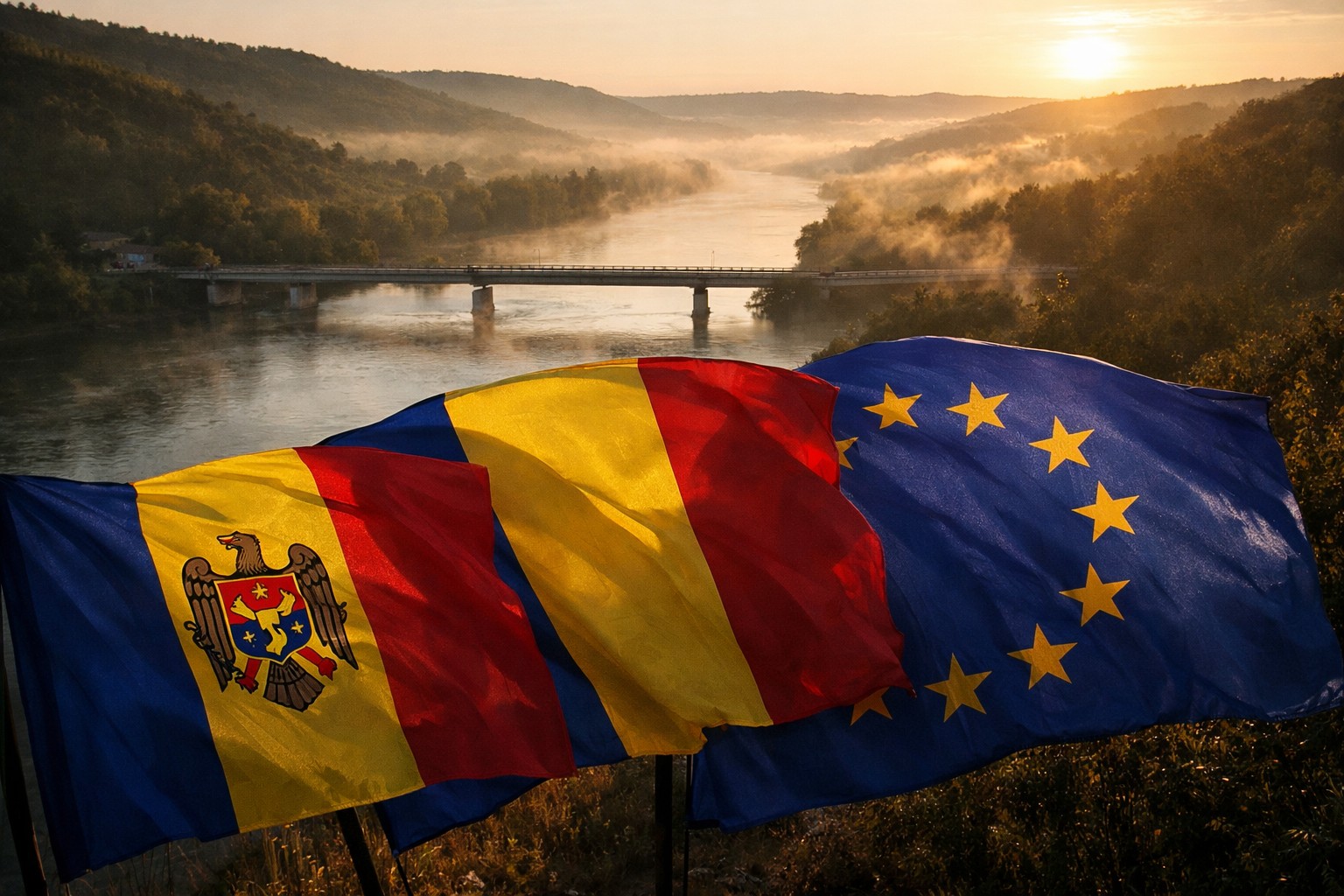
A reported suggestion that Moldova could one day enter the European Union by unifying with Romania has reignited one of Eastern Europe’s most sensitive political questions, linking Chisinau’s European ambitions to a century-old argument over identity, sovereignty and security on the EU’s eastern edge. The discussion surfaced after social media posts attributed such a scenario to a Moldovan deputy prime minister, casting it as a fallback if Moldova’s own accession track were delayed. The comments quickly drew attention because they touched a nerve in a country where support for EU membership has risen sharply since Russia’s full-scale invasion of Ukraine, but where the idea of union with Romania remains far more divisive.
The episode comes at a critical moment for Moldova. The country formally opened accession negotiations with the EU in June 2024, alongside Ukraine, after winning candidate status in 2022. President Maia Sandu’s government has made EU integration the central organizing principle of state policy, framing it as both an economic project and a security guarantee for a small state wedged between war in Ukraine and the unresolved separatist conflict in Transnistria.
Even so, any suggestion that Moldova might bypass the long accession process by merging with neighboring Romania carries implications far beyond Brussels. It raises constitutional questions in Moldova, political sensitivities in Bucharest, concerns in Moscow and unease among minorities inside Moldova, while reviving a debate that has resurfaced repeatedly since the Soviet Union collapsed in 1991.
Social Media Claim Draws Scrutiny
The claim spread rapidly after a post on X said Moldova’s Deputy Prime Minister Eugen Osmocescu had described unification with Romania as a “Plan B” if the EU failed to advance Moldova’s membership. The framing was striking because Moldova’s government has consistently presented accession on its own merits as the country’s official strategy, with target dates tied to the current reform program rather than any union scenario.
Publicly available reporting and official government communications have emphasized a goal of being ready for accession steps by the end of this decade, with Moldovan leaders often pointing to 2030 as a political horizon for entry if reforms continue and the bloc remains supportive. The specific notion of a fallback through unification is not part of Moldova’s published accession roadmap, and such an outcome would require far-reaching political consent in both Moldova and Romania.
That has not stopped the issue from resonating. In Moldova, statements touching on union with Romania are never treated as routine. They immediately reopen arguments about whether the country’s future lies in consolidating a distinct Moldovan state within Europe or in rejoining Romania, with which it shares language, deep historical ties and a common cultural space.
An EU Bid Gains Speed
Moldova’s turn toward the European Union has accelerated dramatically over the past three years. After Russia launched its full-scale invasion of Ukraine in February 2022, Moldovan leaders argued that the war had shattered old assumptions about neutrality and exposed the vulnerability of countries left outside Europe’s core institutions. The EU granted candidate status to Moldova in June 2022 and agreed in December 2023 to open accession talks, a move formally launched six months later.
Brussels has paired that political support with money and technical assistance. The EU has become Moldova’s largest trading partner, taking well over half of Moldovan exports in recent years, a major shift from the country’s historic dependence on post-Soviet markets. European funding has also expanded for energy interconnections, border management, public administration reform and efforts to reduce Moldova’s exposure to Russian pressure.
European officials have repeatedly linked Moldova’s progress to reforms in the judiciary, anti-corruption institutions, public administration and economic governance. Those requirements are standard for accession candidates, but in Moldova they carry extra weight because the country has spent years battling entrenched oligarchic influence, state capture allegations and chronic weaknesses in the court system.
“Moldova belongs in the European family,” European Commission President Ursula von der Leyen said when the bloc advanced the country’s candidacy, reflecting the EU’s broader political commitment to anchor Moldova in the West.
At home, the government has tried to convert that momentum into democratic legitimacy. In a constitutional referendum held alongside the presidential vote in October 2024, Moldovans backed enshrining the goal of EU membership in the constitution by a narrow margin, underlining both the strength of the pro-European push and the persistence of deep internal divisions.
- Moldova received EU candidate status in 2022.
- The EU agreed to open accession negotiations in December 2023.
- Formal accession talks with Moldova were launched in June 2024.
Union Is an Older Question
The idea of unification with Romania predates Moldova’s EU candidacy by decades. Most of present-day Moldova was part of the Romanian historical region of Bessarabia before being incorporated into the Soviet Union during World War Two. When Moldova became independent in 1991, some political forces advocated immediate union with Romania, arguing that Soviet rule had artificially divided one nation into two states.
That view never became dominant enough to drive state policy. Moldova developed its own institutions, symbols and political identity, while a substantial share of the population continued to identify primarily as Moldovan rather than Romanian. The country’s ethnic mix, which includes large Russian-speaking communities as well as Gagauz, Ukrainian and Bulgarian minorities, also made the issue more sensitive than a simple nationalist project.
Romania, now both an EU and NATO member, has supported Moldova’s European integration for years through diplomacy, investment, energy links and citizenship policies. Hundreds of thousands of Moldovans have obtained Romanian passports, giving them access to the EU labor market and freedom of movement. Yet Bucharest has generally treated formal unification as a matter for democratic choice rather than active state strategy, aware of the regional consequences such a move could trigger.
Polling over the years has shown a marked gap between support for EU integration and support for unification. Surveys vary, but backing for joining the EU has often run well above 50%, while support for union with Romania has usually remained significantly lower, though it can rise during moments of crisis or when framed as a route to prosperity and security.
Why the Idea Divides Moldova
For many Moldovans, Europe and unification are not the same thing. The EU path promises institutional reform, investment and a geopolitical anchor while preserving Moldova as a sovereign state. Union with Romania, by contrast, raises emotionally charged questions about identity, language, representation, regional autonomy and what would happen to populations that feel little connection to Romanian nationalism.
These concerns are particularly acute in regions such as Gagauzia, the autonomous, Turkic-speaking area in southern Moldova, where local leaders have often resisted Chisinau’s westward turn. They are also felt in relation to Transnistria, the Russia-backed breakaway region along the Dniester River, where Moscow maintains troops despite repeated calls for withdrawal. Any serious movement toward unification would almost certainly provoke a sharp reaction there.
Analysts say that while talk of union can energize a segment of Moldova’s pro-Romanian electorate, it can also hand ammunition to pro-Russian parties that accuse the government of eroding sovereignty. That has made successive Moldovan administrations cautious, even when led by politicians firmly committed to European integration.
“European integration is supported by a much broader coalition in Moldovan society than unification with Romania,” said one Chisinau-based political analyst, reflecting a view widely shared by regional experts. “The moment the two are conflated, the debate becomes more polarizing.”
The constitutional and legal hurdles would also be formidable. Any union would require democratic approval through elections or referendums, legislative action in both countries and a settlement, or at least a clear framework, for handling Moldova’s unresolved territorial conflict. There is no sign that such a process is under way.
Bucharest’s Quiet Calculus
Romania has long been Moldova’s closest advocate inside the EU, lobbying for stronger financial support, easier market access and a clearer membership perspective. It has invested in cross-border infrastructure, electricity interconnectors and gas links designed to reduce Moldova’s reliance on Russia. During periods of energy pressure, Romania has become a critical backstop.
Romanian leaders have generally chosen their words carefully on union. Public sympathy for reunification exists in Romania, and political parties occasionally invoke it, but governments in Bucharest have usually framed policy around helping Moldova integrate into Europe rather than openly campaigning for state merger. That approach reflects strategic caution: Romania has little interest in creating a fresh regional crisis on NATO’s frontier.
The economic gap is also part of the equation. Romania’s economy has expanded significantly since joining the EU in 2007, while Moldova remains one of Europe’s poorest countries, despite recent growth and reforms. Full unification would bring not just political symbolism but major fiscal, administrative and social integration costs.
- Romania joined the EU in 2007 and NATO in 2004.
- Romania has been a key supplier of electricity and gas support to Moldova.
- Large numbers of Moldovans hold Romanian citizenship, easing travel and work across the EU.
Moscow Would See a Red Line
Any serious push toward union would be watched closely in Moscow, which has long treated Moldova as part of its sphere of influence. Russia has used trade bans, energy leverage, disinformation and political support for pro-Kremlin actors to shape Moldova’s domestic choices. Since the war in Ukraine began, Moldovan officials have repeatedly accused Russia of trying to destabilize the country, charges Moscow rejects.
Transnistria remains the most obvious flashpoint. The narrow strip of land bordering Ukraine broke away from Moldova in the early 1990s after a brief war and has survived with Russian military and economic backing ever since. Although the conflict is frozen, it has never been resolved, and the presence of Russian troops gives the issue strategic weight far beyond the region’s size.
For the Kremlin, Moldova joining the EU is already unwelcome; Moldova uniting with an EU and NATO member would be interpreted much more sharply. Experts say that is one reason Chisinau has preferred the language of reform, integration and resilience over maximalist geopolitical rhetoric. The government’s pitch to voters has been that Moldova can become securely European without reopening every historical dispute at once.
“The EU track is difficult, but it is institutionally clear,” said a regional security expert. “Union with Romania may sound like a shortcut, but politically and geopolitically it is far more explosive.”
Election Season Sharpens the Message
The timing of the renewed debate matters. Moldova has faced repeated campaigns of disinformation and political interference around major elections and referendums, with officials and Western partners warning that Russia-linked networks are trying to derail the country’s European course. In that environment, provocative statements about identity and sovereignty can quickly become campaign weapons.
President Maia Sandu and her allies have built their appeal around cleaner government, closer ties with Europe and resistance to Russian pressure. Their opponents often counter that EU integration threatens traditional ties, social stability or Moldova’s neutral status. The unification issue fits neatly into that contest because it touches all three fault lines at once.
That helps explain why any off-the-cuff remark, real or mischaracterized, can spread so quickly online. Social media tends to collapse complex constitutional questions into a simple binary: Europe through statehood or Europe through merger. In reality, Moldova’s current policy remains centered on accession as an independent state, and that route still commands the broadest domestic and international support.
The Long Road to Brussels
Even with political backing from the EU, Moldova’s path to membership will be lengthy and uncertain. Enlargement depends not only on domestic reforms in candidate countries but also on unanimity among existing member states, many of which are grappling with their own budget constraints, political fragmentation and enlargement fatigue. Moldova’s relatively small size could make accession easier in some respects, but its security exposure and governance weaknesses complicate the picture.
Still, the strategic logic in Brussels has shifted. Russia’s war against Ukraine has made enlargement less a technocratic exercise than a geopolitical project, especially for states on the bloc’s eastern frontier. Moldova has benefited from that change, winning a level of political attention that would have seemed unlikely just a few years ago.
For now, that remains the main story. Moldova is trying to move faster toward the EU than at any point in its post-Soviet history, while managing the domestic sensitivities that come with a divided society and a dangerous neighborhood. The debate over possible union with Romania is unlikely to disappear, but for the moment it serves more as a reminder of the stakes than as an actionable government blueprint.
Whether Moldova reaches the EU by 2028, 2030 or later will depend on reforms in Chisinau and political will in Europe. What is already clear is that the country’s westward turn has entered a new phase, one in which questions once confined to historical memory now intersect directly with the strategic map of modern Europe.
Disclaimer: This content is aggregated from verified external sources for global news and information purposes only.