
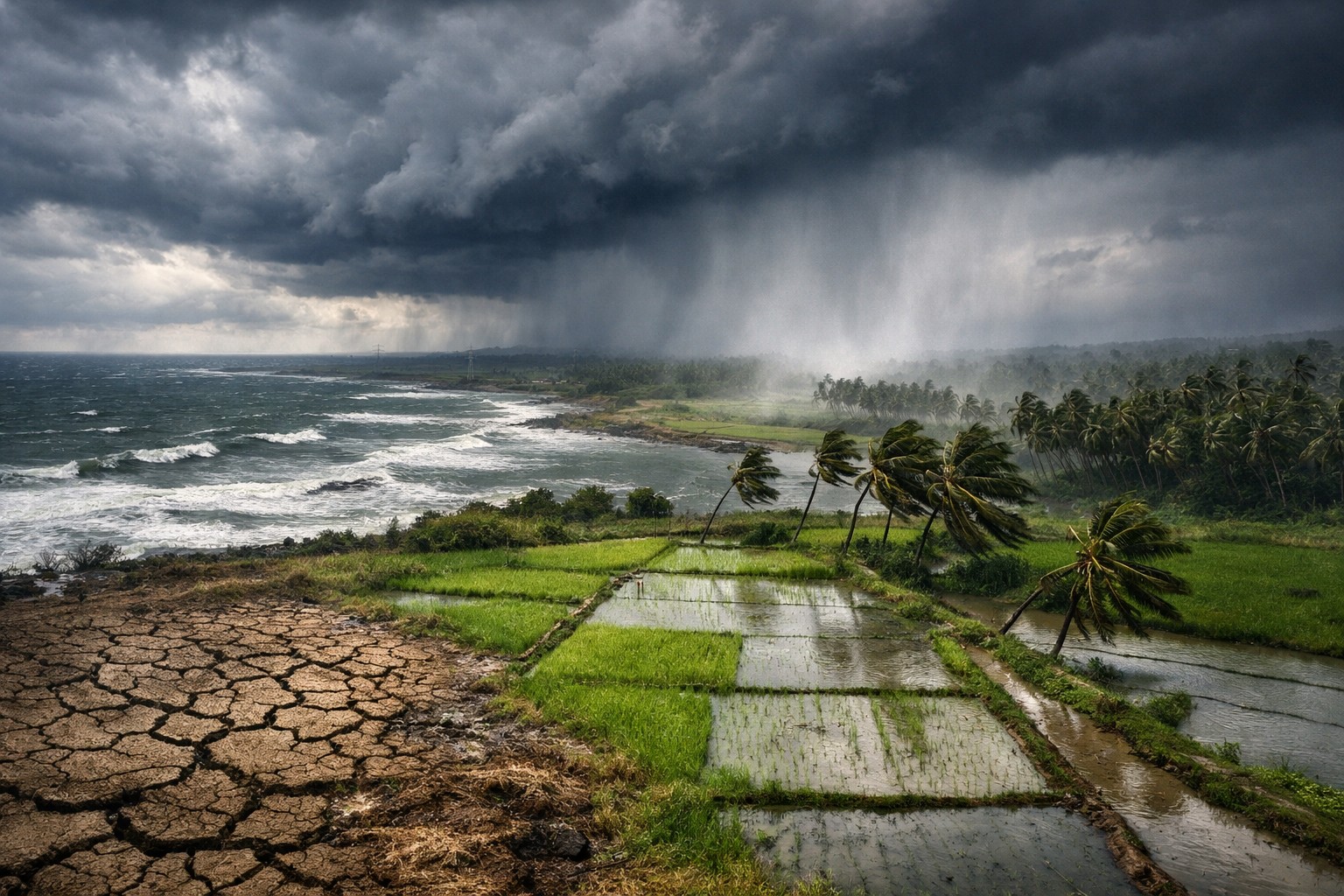
Monsoon Reaches Kerala Late, Testing India’s Farm and Power Outlook
India’s southwest monsoon, the weather system that delivers nearly 70% of the country’s annual rainfall, has reached the southern state of Kerala about three days later than its usual onset date, setting off the annual round of scrutiny from farmers, markets and policymakers. The arrival, confirmed by the India Meteorological Department, is more than a calendar marker: it shapes planting decisions for millions of growers, influences reservoir levels, and can alter the path of food prices in the world’s most populous country. After weeks of punishing pre-monsoon heat in several regions, the first steady rains over Kerala offer relief, but they also reopen a familiar question — whether the season will now gather strength fast enough to support sowing across the farm belt.
Kerala Marks the Turn
The monsoon’s onset over Kerala is the official starting gun for India’s rainy season, even though the system takes weeks to spread north and west across the subcontinent. Under normal conditions, it reaches the state around June 1, and meteorologists use a combination of rainfall, wind patterns and cloud cover to declare the onset. This year’s arrival, while slightly delayed, still falls within the range that forecasters and farm officials generally consider manageable.
The IMD has repeatedly said the onset date by itself does not determine the fate of the entire season. A delayed start can still be followed by a rapid advance and above-average rainfall, while an early onset can lose momentum. What matters more for agriculture is the spatial and temporal distribution of rainfall through June to September, especially during the early sowing window for rice, pulses, soybean and cotton.
For Kerala, the first burst of monsoon rain carries immediate local significance. The state depends on the seasonal downpour for drinking water, hydropower generation and agriculture, and heavy spells can also trigger flooding and landslides in hilly districts if rains intensify too quickly.
Why Three Days Matter
In much of India, the monsoon is effectively the country’s economic heartbeat. About half of India’s farmland is still not fully irrigated, leaving millions of farmers dependent on rain-fed agriculture. A shaky start can delay planting, reduce acreage in some crops, and force farmers to switch to varieties that need less water or mature more quickly.
That helps explain why traders, food companies and central bankers watch the monsoon almost as closely as meteorologists do. Good rains typically support farm output, keep rural incomes steadier and ease pressure on prices of staples ranging from rice to vegetables and sugar-linked crops. Weak or erratic rainfall, by contrast, can feed inflation and put pressure on government food stocks and subsidy programs.
Economists have long noted that the direct contribution of agriculture to India’s gross domestic product has fallen over time, but the monsoon still has an outsized effect on household spending and rural demand. A robust season often boosts purchases of fertilizer, tractors, motorcycles and consumer goods in the countryside, creating knock-on effects well beyond farming.
- India’s southwest monsoon typically runs from June to September.
- The season delivers roughly 70% of the country’s annual rainfall.
- Nearly half of India’s net sown area remains dependent on rainfall rather than assured irrigation.
Forecasts Still Point Higher
The late arrival in Kerala comes against a broader forecast that has, in recent weeks, offered some reassurance. The IMD has projected an above-normal monsoon for the country as a whole this year, with rainfall expected to exceed the long-period average. Private forecasters have also broadly signaled a healthier season than last year, helped by favorable ocean-atmosphere conditions.
One key factor is the fading influence of El Niño, the periodic warming of Pacific Ocean surface temperatures that is often associated with weaker Indian monsoon rainfall. In its place, meteorologists have been watching for the possible development of La Niña, which tends to be more supportive of rainfall over India, though its timing and strength can vary. Conditions in the Indian Ocean, including sea-surface temperature patterns and the Indian Ocean Dipole, also play an important role in shaping the monsoon’s behavior.
Weather specialists caution that a national seasonal forecast can mask sharp regional differences. India can still record average or above-average rainfall overall while some states endure dry spells and others receive damaging excess rain. That uneven distribution has become a bigger concern as climate variability appears to be increasing the frequency of extremes.
The date of onset over Kerala is a useful marker, but what really matters is how the monsoon progresses over the next few weeks and whether rainfall is well distributed across key crop-growing regions.
The assessment, echoed repeatedly by agricultural economists and former weather officials in recent years, reflects a hard-earned lesson from past seasons: the monsoon is judged not by a single day on the calendar, but by what follows.
Farmers Watch the Sowing Window
The next several weeks are crucial for India’s kharif crop cycle, the summer planting season that begins with the rains. Farmers in states such as Maharashtra, Karnataka, Telangana, Andhra Pradesh, Madhya Pradesh and parts of northern India begin sowing after they receive sufficient moisture in the soil. A delayed or interrupted advance can prompt some growers to postpone planting, while a strong follow-through can quickly restore confidence.
Rice, soybean, pulses, cotton, corn and sugarcane all stand to be affected by the rhythm of monsoon rainfall. Rice is especially sensitive because it is central to both food security and export markets. India is one of the world’s largest rice exporters, and changes in domestic production can ripple into global food prices, particularly after the export curbs New Delhi has imposed in recent years to manage local supplies.
For policymakers, the stakes are especially high after episodes of food inflation driven by erratic weather. Vegetable prices have swung sharply in recent seasons due to heat waves, unseasonal rains and supply disruptions. A stable monsoon would help cool some of those risks, though excessive rainfall can be just as damaging as a shortfall if it destroys standing crops or disrupts transport networks.
Farmers don’t need just an early monsoon. They need timely rain at sowing, steady moisture through the vegetative phase, and fewer long dry breaks in between.
That view, often repeated by farm scientists and rural policy experts, captures the difference between a monsoon that merely arrives and one that truly delivers.
Heat, Water and Power Pressures
The monsoon’s arrival also matters for a country that has just come through another intense stretch of summer heat. Large parts of India saw temperatures rise well above seasonal norms in the pre-monsoon period, increasing demand for electricity as homes and businesses leaned heavily on cooling. That surge has strained power systems, lifted coal consumption and sharpened worries over water availability in some cities and farming districts.
Reservoir levels are another key indicator. Low storage heading into the monsoon can leave states more vulnerable if rainfall falters, especially in areas dependent on hydroelectricity or canal irrigation. Early rains in Kerala and a normal-to-strong advance in the weeks ahead could help replenish dams and groundwater, though hydrologists warn that intense short bursts of rain do not always recharge aquifers as effectively as slower, sustained precipitation.
Urban planners and disaster management authorities are balancing two competing risks at once. On one hand, delayed or deficient rainfall can deepen water stress. On the other, cloudbursts and concentrated downpours can overwhelm drainage systems in cities from Mumbai to Bengaluru, disrupt transport, and trigger deadly landslides in vulnerable hill regions.
- Pre-monsoon heat waves have pushed electricity demand sharply higher in recent summers.
- Reservoir replenishment during June-September is critical for irrigation and hydropower.
- Short, intense rainfall events can raise flood risk without fully easing long-term water stress.
Climate Signals Grow Louder
Scientists have become increasingly cautious about drawing straight lines between any single delayed onset and climate change. Yet there is broad agreement that warming temperatures are making India’s rainfall patterns more volatile. Research by Indian and international institutions has pointed to a rise in extreme rain events in parts of central India, even as the number of moderate rainy days has declined in some regions.
That shift matters because agriculture and water management systems were built around a more predictable seasonal cycle. Farmers can struggle when rain arrives in sudden bursts separated by dry stretches. Infrastructure can also be caught off guard: roads, drainage channels and dams are often tested not by seasonal totals but by the intensity of individual events.
The challenge for India is not simply whether this year’s total monsoon rainfall lands above or below average. It is whether the rains come in the right places, at the right time, and with a pattern that rural communities and cities can absorb. That is increasingly the lens through which experts assess risk.
Climate change is loading the dice toward greater variability. Seasonal forecasts are useful, but preparedness now depends on district-level planning for both flood and drought risks.
That warning from climate researchers and disaster specialists has become more urgent as weather extremes increasingly overlap with rapid urbanization and mounting pressure on land and water resources.
Markets and Ministers on Alert
The delayed onset is unlikely by itself to unsettle policymakers, but the monsoon’s progress will be followed closely in New Delhi. The government has a strong incentive to keep food inflation contained, particularly after weather-related price spikes in cereals, onions, tomatoes and pulses have periodically strained household budgets. The Reserve Bank of India, too, watches monsoon conditions as part of its inflation outlook.
Commodity markets often react early to any signs of weather disruption. Traders monitor rainfall maps, sowing data, reservoir levels and crop acreage estimates for clues about production. If rains recover quickly and planting gathers pace, concerns could ease. If the monsoon stalls after the initial onset, pressure may build in markets for edible oils, pulses, sugar and grains.
Government agencies have a range of tools at their disposal, from adjusting buffer stock releases to tweaking import and export rules. But those interventions are often costly and politically sensitive, especially in a country where food prices carry enormous social weight. A smoother monsoon remains the simplest way to reduce those risks.
The Next Two Weeks Count
The focus now shifts from Kerala’s coast to the broader trajectory of the rain-bearing winds. Meteorologists will track whether the monsoon advances steadily into Karnataka, Tamil Nadu, the northeast and then toward central and western India in line with the normal schedule. For farmers waiting to plant, the quality of those next spells matters more than the symbolism of the opening date.
A delay of a few days is not, by historical standards, unusual. India has seen seasons that started late and still ended with ample rainfall, just as it has seen promising starts fizzle into patchy outcomes. What tends to move the economy is not the headline of onset alone, but the pattern of rain through the sowing season and into the critical months that follow.
For now, the first monsoon showers over Kerala bring both relief and caution. Relief, because the rains have finally arrived after oppressive heat. Caution, because in India the real monsoon story is written not in a single announcement, but in the weeks of clouds, winds and water that come after it.
Disclaimer: This content is aggregated from verified external sources for global news and information purposes only.