
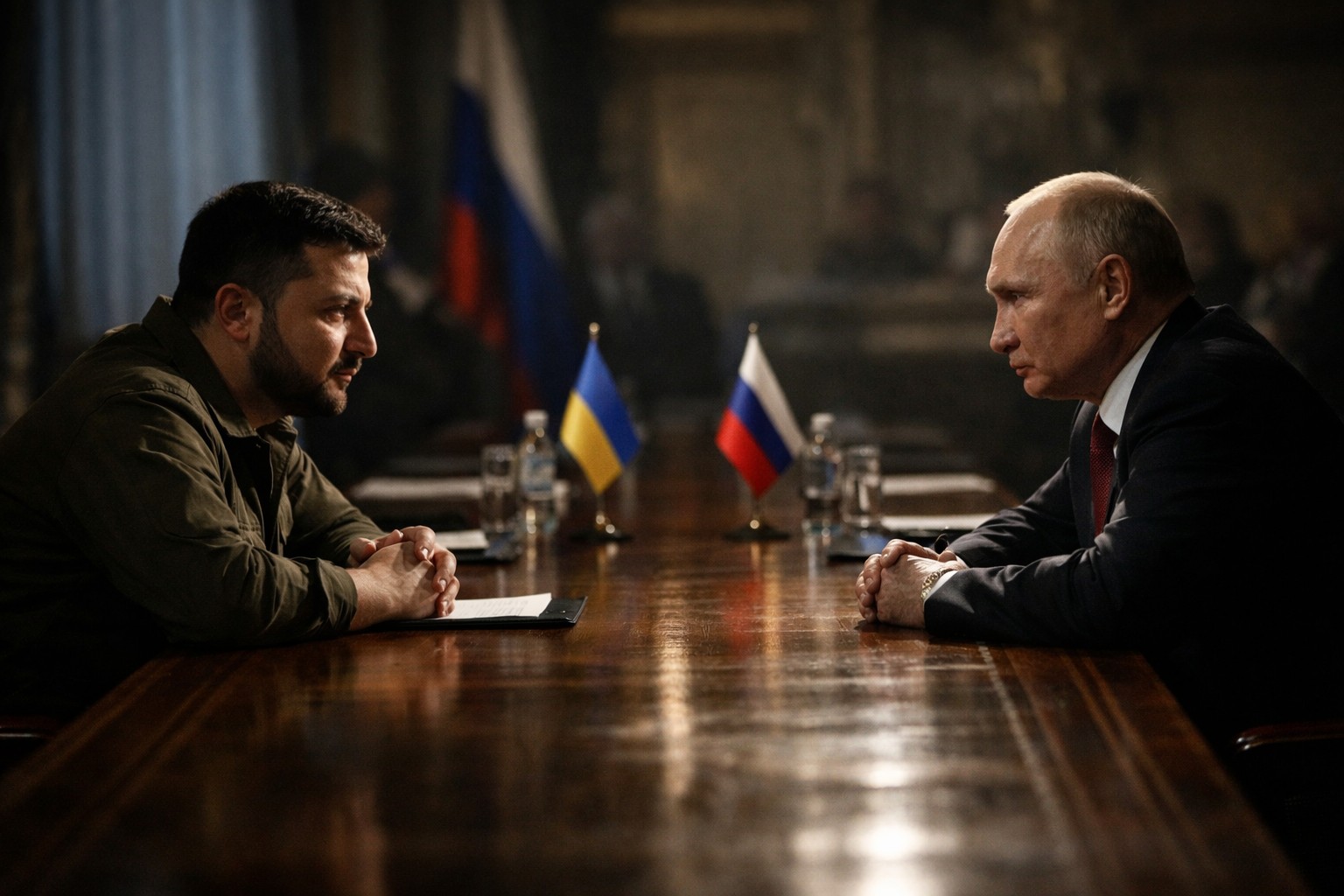
Zelensky Says He Is Ready to Meet Putin as Ukraine Signals Openness to Talks
President Volodymyr Zelensky has said he is ready to meet Russian President Vladimir Putin in person to discuss ending the war, a fresh public signal that Kyiv wants to test whether Moscow is willing to move beyond declarations and into direct negotiations. The overture, circulated online in a letter highlighted by social media accounts including Visegrád24, comes at a moment when both sides are under mounting military and political strain, with Russia pressing attacks along the front and Ukraine continuing long-range drone strikes deep inside Russian territory. Any such meeting would mark the first face-to-face encounter between the two leaders since Russia launched its full-scale invasion in February 2022, but the path to talks remains crowded with conditions, mistrust and sharply different views of what peace would look like.
Offer Paired With Defiance
Zelensky’s message was notable not only for its willingness to engage directly with Putin, but also for the tone that accompanied it. In the excerpts circulated online, the Ukrainian leader mixed an offer of personal diplomacy with barbed language about Ukrainian drone attacks, underscoring Kyiv’s long-running argument that negotiations cannot be detached from pressure on the battlefield.
The quoted line about long-range drones referred to strikes that have become a prominent feature of Ukraine’s strategy over the past two years. Kyiv has increasingly used domestically developed drones to hit military facilities, fuel depots, airfields and infrastructure inside Russia, arguing that such operations are a legitimate response to Moscow’s assault on Ukrainian cities and energy systems.
“The absolute majority of Ukrainians are positive about the fact that our long-range drones attended the opening of your forum,” Zelensky was quoted as writing in the letter excerpts circulated on social media.
Reuters and other international outlets have previously reported that Zelensky has repeatedly said Ukraine is prepared for a just peace, but not for terms that amount to capitulation. His public line has evolved from the earlier wartime position that talks were impossible while Putin remained in power, to a more recent insistence that any negotiations must be grounded in international law, sovereignty and security guarantees.
Kyiv Tests Moscow’s Intentions
The latest message fits a broader pattern in which Ukraine has tried to demonstrate flexibility to international partners while keeping pressure on the Kremlin. Zelensky has spent months calling for a diplomatic framework built around Ukraine’s territorial integrity, prisoner exchanges, food and nuclear security, and the return of deported children. At the same time, Kyiv knows many of its allies are increasingly focused on whether a military stalemate can be turned into a political process.
There is a practical reason for making the offer public. By saying he is ready to meet Putin directly, Zelensky places the burden on Moscow to respond, either by engaging or by appearing to reject a personal format that Russia itself has often said should not be ruled out in principle. Diplomats say such signaling matters because both sides are trying to shape how Washington, European capitals and countries in the Global South interpret responsibility for the absence of talks.
Russia has repeatedly said it is open to negotiations, but its conditions have remained largely unchanged. The Kremlin has insisted that any settlement must reflect what it calls the “realities on the ground,” shorthand for Russian control over occupied Ukrainian territory, including areas Moscow claimed to annex in 2022 despite not fully controlling them.
“We have never refused negotiations,” Putin said at various points over the course of the war, while arguing that Ukraine would need to accept territorial and security realities created by Russian military action.
That formula is unacceptable to Kyiv, which says recognition of Russian territorial gains would reward aggression and invite future wars. Ukrainian officials have also argued that previous rounds of talks with Moscow, including contacts in the early weeks of the invasion, collapsed because Russia continued military operations while demanding far-reaching concessions on neutrality, territory and force posture.
Years of Broken Channels
Direct contact between Zelensky and Putin has been rare even by the standards of wartime diplomacy. The two leaders met in December 2019 in Paris during a summit hosted under the so-called Normandy format, alongside French and German leaders, when the conflict in eastern Ukraine was still officially framed as a war in the Donbas rather than a full-scale interstate invasion. That meeting produced limited movement on prisoner exchanges and ceasefire issues, but it did not resolve the core dispute over sovereignty and control.
After Russia launched its all-out invasion in 2022, negotiators from both countries held talks in Belarus and later in Turkey. There was brief speculation that a framework could emerge around Ukrainian neutrality and security guarantees, yet the effort collapsed amid ongoing combat, distrust over Russian intentions and the shock of evidence of atrocities in places such as Bucha after Russian forces withdrew from areas near Kyiv.
Ukraine later formalized a much harder stance. In October 2022, Zelensky enacted a decision of Ukraine’s National Security and Defense Council declaring talks with Putin impossible, though Ukrainian officials and legal experts have since suggested the measure reflected the circumstances of that moment and did not permanently preclude future diplomatic formats if conditions changed. His latest message suggests Kyiv wants room to maneuver without giving up its core demands.
- Ukraine insists any durable deal must preserve its sovereignty and internationally recognized borders.
- Russia says peace must account for territorial changes and Ukraine’s military status.
- Western governments broadly back talks in principle, but say the terms cannot be imposed on Kyiv.
Drone War Reaches Deep Russia
The reference to drones in Zelensky’s letter points to one of the war’s clearest shifts. Ukraine entered the conflict with limited ability to strike at long range, but has built a growing domestic industry producing attack drones and other systems capable of reaching targets hundreds, and in some cases more than a thousand, kilometers away. Those strikes have targeted oil refineries, military airfields, logistics hubs and industrial sites linked to Russia’s war effort.
Russia, for its part, has escalated its own long-range attacks using missiles, glide bombs and large waves of drones, many of them based on Iranian-designed Shahed systems. Ukrainian officials say the goal of their strikes inside Russia is not symbolic revenge but disruption of the infrastructure that enables Moscow to sustain the war. Russian authorities have accused Kyiv of terrorism, while often downplaying the material impact of successful strikes.
Military analysts say this duel has changed the strategic picture even if it has not produced a decisive breakthrough. By threatening refineries and air bases, Ukraine can impose costs on Russia far from the front. By continuing to pound Ukrainian energy and civilian infrastructure, Moscow seeks to exhaust the population, undermine the economy and weaken confidence in the government.
“Long-range precision strike has become one of the few tools available to Ukraine to offset Russia’s advantages in manpower and munitions,” several Western analysts have argued in public assessments over the past year, describing drone warfare as both a military and political instrument.
The symbolism matters too. When Zelensky links diplomacy to strikes on Russian territory, he is signaling that negotiations would take place not from a position of helplessness, but in the middle of a campaign designed to show that Russia cannot wage war without paying a price at home.
Moscow’s Terms Stay Hard
Any serious move toward a meeting would run into an obstacle that has stymied virtually every peace discussion since 2022: the gap between the minimum terms each side can publicly accept. Putin said in mid-2024 that Ukraine would need to withdraw troops from the four regions Russia claims to have annexed — Donetsk, Luhansk, Zaporizhzhia and Kherson — and formally abandon its NATO ambitions before Russia would move toward a ceasefire. Kyiv rejected that proposal as an ultimatum, not a peace offer.
Zelensky has promoted what he calls a peace formula centered on the UN Charter, territorial integrity, accountability for war crimes and postwar security guarantees. Although Ukraine has since shown more openness to phased diplomacy and partial agreements on issues such as grain shipping, prisoners and nuclear safety, there is no sign it would accept Russia’s demand for legal recognition of occupied land.
The Kremlin also sees time differently. Russian forces have continued offensive operations in the east, using superior manpower and heavy use of glide bombs and artillery to grind forward at high cost. That battlefield posture gives Moscow little obvious incentive to soften its terms unless military or economic pressure becomes substantially more painful.
“Any negotiations must start from the realities on the ground,” Russian officials have repeatedly said, a phrase Kyiv interprets as a demand to ratify territorial seizure by force.
- Russia controls roughly a fifth of Ukrainian territory, though front lines remain contested and fluid in several sectors.
- Ukraine relies heavily on Western military aid, air defense and budget support to sustain the war effort.
- Neither side has demonstrated the ability to impose a decisive military victory in the near term.
Allies Watch for Signals
Zelensky’s latest outreach will be closely watched in Washington and across Europe, where governments continue to back Ukraine but are also increasingly discussing the shape of an eventual settlement. The United States and major European powers have said repeatedly that they will support diplomacy when Ukraine decides the time is right. At the same time, officials remain wary of any process that could freeze the conflict on terms favorable to Russia.
The debate has sharpened as the war drags on into its fourth year and Western domestic politics grow more complicated. In the United States, aid to Ukraine has become entangled in broader political battles. In Europe, governments face fiscal constraints, military stockpile pressures and voter fatigue, even as many leaders argue that a Russian victory would create larger long-term security costs for the continent.
Countries outside the transatlantic alliance are also part of the equation. Ukraine has tried to build support in Asia, Africa and Latin America by framing its peace formula around food security, nuclear safety and respect for borders. Russia has worked to cast the war as a broader confrontation with the West and to persuade non-Western states that sanctions, not the invasion itself, are chiefly responsible for global disruption.
“Nothing about Ukraine without Ukraine,” Western officials have said consistently, emphasizing that Kyiv must decide whether direct talks with Putin are politically and strategically worth pursuing.
A Narrow Path to Talks
For now, a face-to-face meeting remains more a test of political positioning than an imminent diplomatic breakthrough. The gap between Kyiv and Moscow is vast, and neither side appears ready to make the concessions that would be needed even for a preliminary ceasefire. Still, public offers matter in long wars, especially when military progress is incremental and each camp wants to show allies and domestic audiences that it is not the obstacle to peace.
If a meeting were ever to happen, officials and analysts say it would likely require preparatory work on narrower issues first. Those could include expanded prisoner exchanges, protections for energy infrastructure, maritime arrangements in the Black Sea, or confidence-building steps involving nuclear facilities and deported civilians. Such measures would not end the war, but they could provide the scaffolding for a higher-level political encounter.
The central problem remains unchanged since the first failed talks of 2022: Ukraine wants a settlement that secures its statehood and deters another invasion, while Russia still seeks to convert military aggression into lasting political leverage. Zelensky’s letter may have reopened a line of public diplomacy, but whether it leads anywhere will depend less on rhetoric than on whether the Kremlin is prepared to compromise on aims it has defended for more than three years of full-scale war.
Disclaimer: This content is aggregated from verified external sources for global news and information purposes only.