
Taiwan targets 1,800 anti-ship missiles by 2029 as China pressure mounts
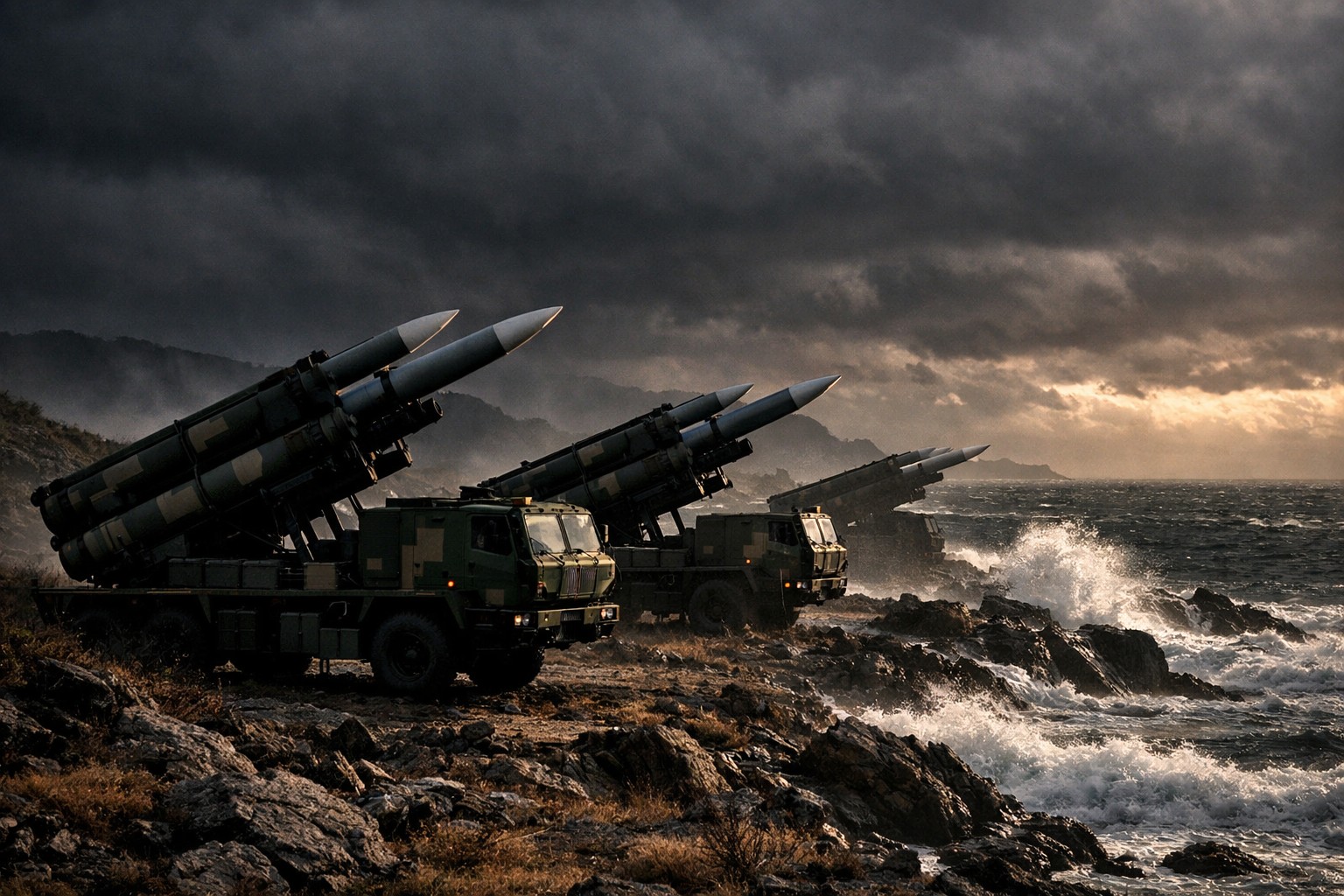
Taiwan plans to build its stockpile of anti-ship missiles to more than 1,800 by early 2029, according to a Reuters review of government targets and production plans, underscoring how the island is reshaping its military around the threat of a Chinese invasion or blockade. The push centers on mobile, land-based weapons designed to strike Chinese warships from shore, a strategy Taiwanese officials and outside analysts say offers one of the clearest paths to deterring a numerically superior People’s Liberation Army. It comes as Beijing intensifies military drills around Taiwan and ratchets up political pressure on President Lai Ching-te’s government.
The missile buildup reflects a broader shift in Taiwan’s defense planning away from prestige platforms and toward what military planners often call an asymmetric approach: cheaper, survivable systems that can make any attack painfully costly. For Taipei, the logic is straightforward. China’s navy is the world’s largest by number of hulls, and any conflict would likely begin at sea, whether through an outright amphibious assault or a quarantine aimed at strangling Taiwan’s trade-dependent economy.
Taiwan’s planned increase would rely heavily on the domestically produced Hsiung Feng series, especially the subsonic Hsiung Feng II and the supersonic Hsiung Feng III, according to public budget documents, legislative material and defense analyses. Those missiles can be dispersed across the island on mobile launchers, helping them survive a first wave of strikes and complicating Chinese targeting. The expansion also dovetails with a growing list of U.S.-backed security measures, including purchases of coastal defense systems, drones and munitions intended to blunt a cross-strait assault.
Missiles at the center
At the heart of the plan is Taiwan’s belief that anti-ship missiles are among the few tools capable of exploiting China’s vulnerabilities in the narrow waters of the Taiwan Strait. The island’s Defense Ministry and the state-run National Chung-Shan Institute of Science and Technology have steadily expanded production capacity in recent years, with lawmakers approving funds for new batches of coastal defense missiles and related launcher vehicles. Publicly available figures indicate Taipei has sought to accelerate output after Russia’s invasion of Ukraine reinforced the value of mobile, hard-to-detect systems.
The Hsiung Feng II, a longer-serving workhorse of Taiwan’s arsenal, provides a sea-skimming subsonic option with a range often estimated by defense experts at roughly 160 kilometers or more, depending on the variant. The Hsiung Feng III, developed as a faster and harder-to-intercept weapon, is generally believed to have a range of around 150 to 400 kilometers depending on model and launch profile, though many exact specifications remain classified. Together, analysts say, they offer layered coverage against amphibious ships, destroyers and support vessels that would be critical to any Chinese operation.
The emphasis on anti-ship firepower reflects a practical military calculation:
- China would need to move large numbers of troops and equipment across water in any full-scale invasion.
- Taiwan can use geography, coastal terrain and dense urban areas to make missile launchers harder to find and destroy.
- Sea denial, rather than sea control, is a more realistic goal for a smaller military facing a much larger navy and air force.
Taiwan has also ordered 100 U.S.-made Harpoon Coastal Defense Systems in a deal approved by Washington in 2020, with deliveries expected in phases over the second half of the decade. Those systems are intended to complement indigenous missiles rather than replace them. The mix gives Taipei more flexibility, but it also raises a familiar challenge: converting procurement plans into usable combat power quickly enough to keep pace with China’s military modernization.
Beijing’s military pressure grows
China considers democratically governed Taiwan part of its territory and has never renounced the use of force to bring the island under its control. Since then-U.S. House Speaker Nancy Pelosi visited Taipei in August 2022, the People’s Liberation Army has sharply increased the scale and tempo of operations near Taiwan, sending warships and military aircraft across the median line of the Taiwan Strait and staging drills that simulate encirclement. Beijing has framed those exercises as warnings against what it calls separatist activity and foreign interference.
Under President Xi Jinping, China has set a more urgent tone on unification, though it has not publicly set a timetable for military action. U.S. officials have repeatedly said Beijing is working to ensure its military can credibly threaten or execute an operation against Taiwan in the coming years, even if no final decision has been made. Annual Chinese defense spending, officially about 1.67 trillion yuan in 2024 — roughly $230 billion — dwarfs Taiwan’s budget, though outside analysts estimate China’s true military outlays are higher.
Taiwan’s defense officials argue that the danger is not limited to a classic invasion scenario. A blockade, quarantine or campaign of coercive strikes could seek to break public morale and isolate the island without immediately landing troops. That possibility has become central to Taiwan’s planning because the island imports much of its energy and food and depends heavily on seaborne trade.
“The challenge for Taiwan is to deter not just the landing force, but the coercive campaign that could begin well before a landing,” said Bonny Lin, director of the China Power Project at the Center for Strategic and International Studies. “Anti-ship missiles are vital because they threaten the ships China would need for both blockade enforcement and invasion support.”
Chinese officials routinely reject the idea that their military posture is destabilizing, saying pressure is directed at separatists and external backers. Beijing’s Taiwan Affairs Office has accused Lai’s administration of raising tensions by promoting a distinct Taiwanese identity and deepening security ties with the United States.
A doctrine forged by doubt
Taiwan’s missile buildup is also a story about internal military debate. For years, U.S. and Taiwanese analysts urged Taipei to devote more resources to survivable coastal defense, sea mines, portable air defenses and drones rather than expensive conventional platforms such as fighter jets, tanks and large surface ships. The argument was not that those systems had no role, but that they offered less value if China could strike bases and ports early in a conflict.
The shift gathered momentum under former President Tsai Ing-wen, who extended mandatory military service from four months to one year for men born after 2005 and raised annual defense spending. Taiwan’s defense budget for 2025, including special allocations, reached about T$647 billion — roughly $20 billion — or around 2.5% of GDP, according to government figures. Lai has signaled continuity, pressing for faster military reform while calling deterrence the best path to preserving peace.
Even so, doubts persist about Taiwan’s readiness. U.S. lawmakers and defense experts have warned about training shortfalls, reserve mobilization gaps and delays in receiving American weapons due to backlogs. Taiwan has acknowledged those bottlenecks and sought to expand domestic manufacturing, in part to reduce dependence on foreign delivery schedules.
“If Taiwan can field large numbers of mobile anti-ship missiles, it raises the costs and uncertainty for Beijing,” said Drew Thompson, a senior fellow at the S. Rajaratnam School of International Studies in Singapore. “But missiles alone are not enough. They need targeting, logistics, dispersal, camouflage and trained crews that can operate under intense pressure.”
The lesson drawn in Taipei from Ukraine has been less about mirroring that war than about endurance. Officials say a defender that can survive initial strikes and continue imposing losses may alter an attacker’s calculus before a conflict begins. That thinking has given new political cover to investments in relatively unglamorous munitions that can be produced in larger numbers.
Industry ramps up production
Taiwan’s domestic defense industry has become a central player in that strategy. The National Chung-Shan Institute of Science and Technology, the island’s premier military research body, has expanded facilities and added production lines for missiles and drones after securing multiyear government support. Lawmakers have approved special budgets over several cycles to fund precision munitions, surveillance systems and stockpiling efforts.
Production targets have been shaped by both urgency and hard industrial constraints. Building missiles at scale requires rocket motors, seekers, electronics and launch vehicles, all of which depend on specialized suppliers and trained labor. Taiwan has not released a complete official breakdown of annual output, but defense budget material and local media reports have pointed to rising production goals for Hsiung Feng systems through the second half of the decade.
That effort sits alongside a broader military procurement push that includes:
- Harpoon coastal defense missiles and radar systems from the United States.
- MQ-9B drones and other surveillance assets aimed at improving maritime awareness.
- Indigenous submarines, mine-laying programs and loitering munitions meant to thicken Taiwan’s defenses.
Taiwan’s first domestically built submarine, unveiled in 2023, symbolized the government’s determination to show visible progress on self-reliance. Yet many analysts say anti-ship missiles may prove more immediately useful because they are cheaper, easier to disperse and faster to field in meaningful numbers. The military challenge is to integrate those systems into a joint network that can keep functioning even if command nodes come under attack.
One unresolved question is how quickly Taiwan could replenish stocks during a prolonged crisis. Unlike peacetime procurement, wartime production would face power disruptions, supply chain shocks and possible strikes on factories. That has reinforced arguments for building deeper inventories now rather than betting on resupply after hostilities begin.
Washington backs the shift
The United States remains Taiwan’s most important international security partner, even though Washington does not maintain formal diplomatic relations with the island. Under the Taiwan Relations Act, the United States is committed to providing Taiwan with defensive arms, and successive administrations have approved billions of dollars in sales. Recent packages have increasingly emphasized munitions, sensors and systems tailored to a denial strategy rather than conventional force-on-force competition.
President Joe Biden has repeatedly said U.S. forces would defend Taiwan in the event of a Chinese attack, remarks the White House has later folded back into the long-standing policy of strategic ambiguity. At the same time, American officials have pressed Taipei to move faster on reforms that would make the most of the weapons it is buying. A congressional commission and Pentagon-linked assessments have argued that stockpiles of anti-ship and air-defense missiles are particularly urgent.
“Taiwan should prioritize capabilities that are mobile, survivable, lethal and cost-effective,” Elbridge Colby, now widely cited among U.S. defense strategists on Taiwan planning, wrote in earlier policy work that has influenced the debate in Washington.
For Taiwan, the support is valuable but not uncomplicated. Arms deliveries have been slowed by U.S. industrial bottlenecks, and Taipei has faced a backlog estimated in the tens of billions of dollars in undelivered equipment in recent years, though some figures fluctuate as contracts move forward. Those delays have sharpened pressure on Taiwan to produce more of its own missiles and ammunition at home.
Japan and some European governments have also begun speaking more openly about stability in the Taiwan Strait as a matter of international security, not only regional concern. Still, few countries are willing to define how they would respond in a conflict. That uncertainty strengthens Taiwan’s argument that the first line of deterrence must be built on the island itself.
Markets and shipping watch closely
Any confrontation over Taiwan would reverberate far beyond the military balance. The island sits at the center of global technology supply chains through Taiwan Semiconductor Manufacturing Co, which produces the majority of the world’s most advanced chips. It also lies astride shipping routes linking Northeast Asia with the South China Sea and beyond, making even a limited blockade scenario a major concern for trade, insurance and financial markets.
Analysts at major risk consultancies have warned that coercive Chinese measures short of war could still disrupt commerce by driving up freight rates, rerouting vessels and unnerving investors. Taiwan’s economy, worth roughly $790 billion, is highly exposed to maritime trade, while China would also face significant blowback from any severe crisis. That mutual exposure is one reason many economists still see outright conflict as a high-cost outcome that all sides have reason to avoid.
Yet recent exercises by China’s military have shown how quickly nerves can fray. During large-scale drills, commercial airlines adjusted routes, shipping companies monitored advisories and regional militaries elevated surveillance. The missile buildup is meant to ensure that those episodes do not evolve into something more dangerous without Beijing having to confront serious military risk.
- Taiwan supplies a critical share of advanced semiconductors used in smartphones, servers and AI systems.
- Nearly half of the world’s container fleet by tonnage passes through the broader waters of East and Southeast Asia.
- Energy imports leave Taiwan especially vulnerable to any prolonged disruption at sea.
That economic backdrop helps explain why Taiwan’s security choices are being watched as closely in boardrooms as in defense ministries. A bigger missile arsenal may not eliminate the danger, but it is intended to sharpen the message that coercion would carry real costs from the opening hours of any crisis.
The next test for Taipei
The ambition to field more than 1,800 anti-ship missiles by early 2029 will now be measured not by headline numbers alone, but by whether Taiwan can weave those weapons into a credible wartime posture. That means more launcher vehicles, resilient communications, realistic exercises and stockpiles of spare parts and fuel. It also means persuading the public and lawmakers to sustain defense spending even as social and economic priorities compete for funds.
China is unlikely to stand still while Taiwan rearms. The PLA continues to improve its missile forces, naval aviation, cyber capabilities and capacity to strike ports, airfields and command centers across the island. Any deterrent strategy, analysts say, will be a race between Taiwan’s ability to complicate an attack and China’s ability to suppress those defenses quickly.
“Deterrence is not a single weapon or a single purchase,” said Amanda Hsiao, senior analyst for China at Eurasia Group. “It is the cumulative effect of capabilities, political resolve and the attacker’s uncertainty about whether it can succeed at acceptable cost.”
For now, Taiwan’s answer is to lean harder into missiles that can hide, move and strike at the ships China would need to control the strait. The bet in Taipei is that if enough of those weapons are in place by the end of the decade, the most dangerous scenarios may remain exactly that: scenarios, not events.
Disclaimer: This content is aggregated from verified external sources for global news and information purposes only.